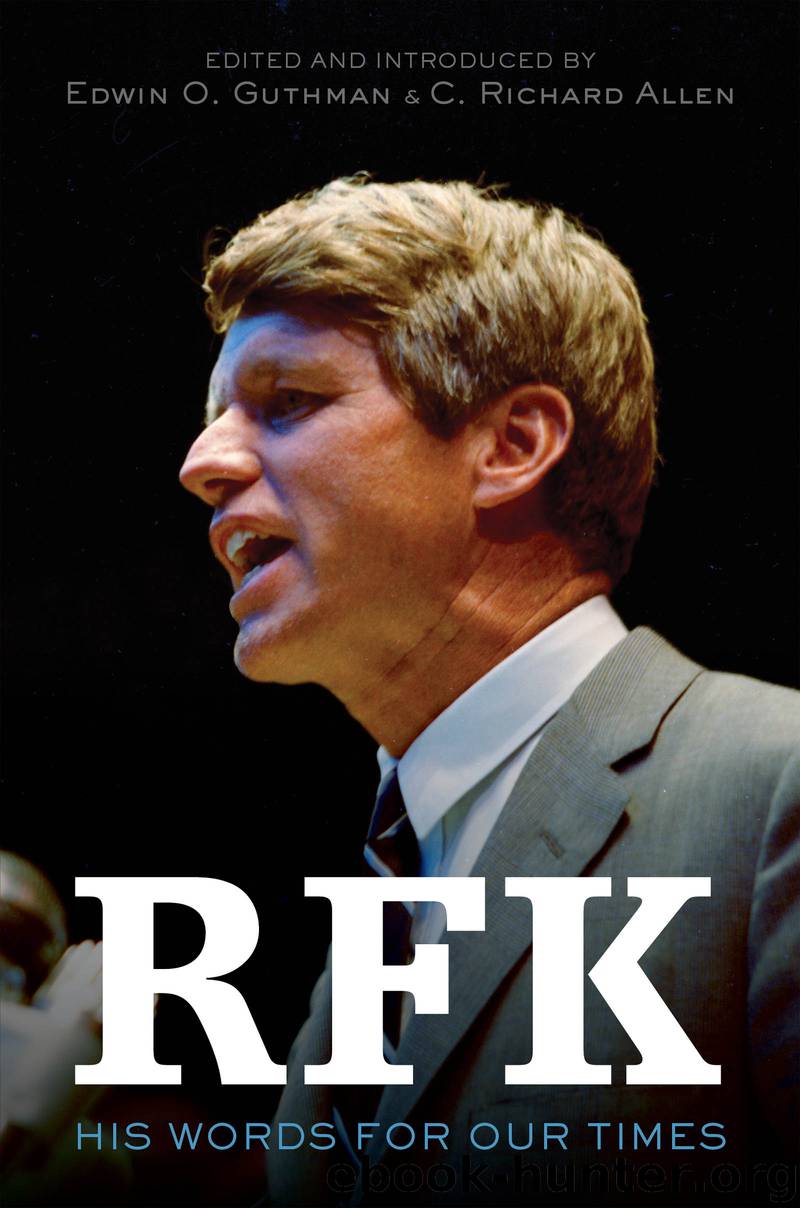
RFK by Robert F. Kennedy
Author:Robert F. Kennedy
Language: eng
Format: epub
Publisher: HarperCollins
Published: 2018-03-25T16:00:00+00:00
Filling Out a Domestic Agenda
BY THE TIME HE BROKE BREAD with Chavez and prepared for his struggle on the presidential campaign trail, Kennedy had confounded many of his Senate colleagues during his more than three years in the Capitol. When he took office in 1965, many assumed that his reputed aggressive individualism would render him ineffective in such a ritualistically collegial body, and that his presumed ambition for the presidency would make the Senate a way station, not a place for substantive accomplishment. Kennedy had proven them wrong.
His passion and persistence regarding emergency food assistance for Mississippi’s poor showed that he could channel his impatience, marshal the media, work with his colleagues, outmaneuver the administration, and win a small but signal victory for people in dire need. As a war where most of the battles had to be won by staff, it also demonstrated Kennedy’s ability to field an unparalleled cadre of aides—a characteristic that had marked his team of investigators on the Rackets Committee, his campaign structure in 1960, and his staff at the Justice Department.
If Kennedy’s activism on behalf of the nation’s poor, hungry, and disenfranchised marked a recurring chorus in his years in the Senate, there were myriad other melodies. He authored and directed the passage of important amendments to legislation concerning education (establishing standards and accountability for federally mandated programs), housing, narcotics, Medicare, health services, voting rights, economic development, and cigarette labeling and advertising, among others. In addition, Kennedy presented a detailed campaign-finance reform package in committee testimony, and he introduced a sophisticated bill to overhaul Social Security.
To demonstrate this breadth, four speeches are excerpted. The first two, delivered in 1966 in upstate New York and suburban Minnesota, respectively, indicate the extent to which Kennedy was committed to transcending liberal dogma, by demanding that well-intentioned but ineffective government programs be redirected or scrapped, and by advocating a renewed commitment to individual effort and responsibility in the service of the traditional ideal of community. In the third and fourth speeches, Kennedy warned of menaces not then generally appreciated but that clearly haunt contemporary America: pollution and handgun violence, the subjects of remarks in January and July 1967.
Download
This site does not store any files on its server. We only index and link to content provided by other sites. Please contact the content providers to delete copyright contents if any and email us, we'll remove relevant links or contents immediately.
| Africa | Americas |
| Arctic & Antarctica | Asia |
| Australia & Oceania | Europe |
| Middle East | Russia |
| United States | World |
| Ancient Civilizations | Military |
| Historical Study & Educational Resources |
Cat's cradle by Kurt Vonnegut(15362)
Pimp by Iceberg Slim(14517)
4 3 2 1: A Novel by Paul Auster(12398)
Underground: A Human History of the Worlds Beneath Our Feet by Will Hunt(12100)
The Radium Girls by Kate Moore(12033)
Wiseguy by Nicholas Pileggi(5791)
The Fire Next Time by James Baldwin(5452)
Perfect Rhythm by Jae(5409)
American History Stories, Volume III (Yesterday's Classics) by Pratt Mara L(5310)
Paper Towns by Green John(5194)
Pale Blue Dot by Carl Sagan(5012)
A Higher Loyalty: Truth, Lies, and Leadership by James Comey(4965)
The Mayflower and the Pilgrims' New World by Nathaniel Philbrick(4506)
The Doomsday Machine by Daniel Ellsberg(4492)
Killers of the Flower Moon: The Osage Murders and the Birth of the FBI by David Grann(4449)
The Sympathizer by Viet Thanh Nguyen(4396)
Too Much and Not the Mood by Durga Chew-Bose(4349)
The Borden Murders by Sarah Miller(4329)
Sticky Fingers by Joe Hagan(4204)
